
📦 WE SHIP WORLDWIDE. 🌍 IF YOU ARE IN A COUNTRY OUTSIDE INDIA, & WANT TO COLLECT BOOKS, JUST WHATSAPP US CLICKING ON THE WHATSAPP ICON.
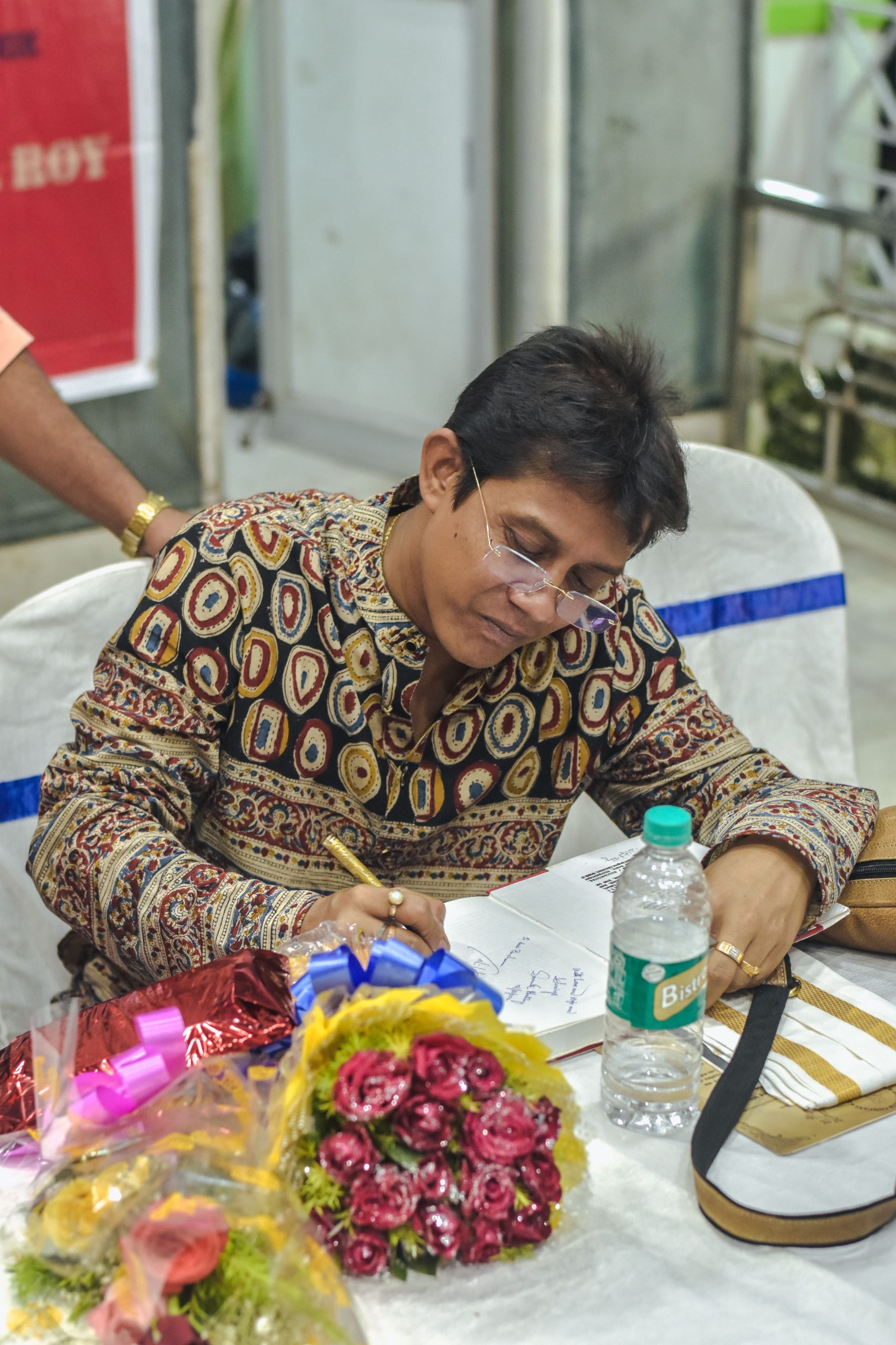
Born : 19 th June 1978, Calcutta (now Kolkata), India.
Nationality : Indian.
Alma mater : University of Calcutta.
Avocation : Writer, thinker, literary critic, and commentator on culture.
Years active : 1997 – Present.
Region : Experimental literature.
Genre : Experimental novel, experimental short story, experimental poetry, experimental drama, personal essay, analytical critique, literary treatise.
Spouse : Moumita Roy Biswas.
Main interests : Indian mythology, Sanskrit literature, Greek mythology, Roman mythology, Absurdism, Postmodernist experimental prose and poetry, Modernist experimental prose and poetry, Avant-garde theatre, Literary theory, Literary criticism, European philosophy, Psychoanalytic literary criticism, Psychological realism in literature, Experimental prose in Bengali literature, Bengali little magazine movement, History of primitive Kolkata, Bengali folklores (songs, riddles, proverbs & tales), Bengali stage theatre, Experimental film.
Influenced by : Magha, Rajashekhara, Bharavi, Nirad C. Chaudhuri, Sajani Kanta Das, Kamal Kumar Majumdar, Subimal Mishra, Nabarun Bhattacharya, Ritwik Ghatak, Muppala Ranganayakamma, Francois Rabelais, Miguel de Cervantes, Mikhail Bulgakov, Robert Kroetsch, Jorge Luis Borges, James Joyce, Jean Paul Sartre, T. S. Eliot, Friedrich Nietzsche, Franz Kafka, Samuel Beckett, Albert Camus, William Burroughs, David Markson, George Lukacs, Roland Barthes, Michel Foucault, Jean Baudrillard, Jean Luc Godard.
Notable ideas : Third degree literature; Nilotpalesque aporia; Nilotpalesque genre.
Nilotpal Roy [নীলোৎপল রায়] (born 19th June 1978) is an Indian writer, thinker, literary critic, and commentator on culture. He is a bi-lingual novelist, essayist, poet, playwright, and short story writer. He writes with equal flair in two languages — in English, and in his vernacular Bengali. So far, he is best known for his bold, maverick, and unforeseen styles of writing, as well as for his unconventional ways of thinking. As the immense magnitude of his erudite brain as well as his ganglionic pen ranges from ‘samizdat’ via ‘tamizdat’ to ‘magnitizdat’, since ‘blue blouse’ through ‘aleatoricism’ unto ‘degree zero’; he offers with effortless ease, a sojourn to cerebral literature.
On 22nd May 2016, his debut English novel ‘Pastiche of Angst’1 was officially inaugurated at Gyan Manch in Kolkata which is so far his magnum opus.2 As the chief guest, Professor Abhijit Gupta of Jadavpur University delivered an introspective introduction to this experimental fiction.3 The author himself being an extraordinary orator also conveyed an excellent speech explicating his vision as a writer.4 Scandalously frank, wittily erudite, mercurially sui generis, effervescently inventive, and versatilely fecund, ‘Pastiche of Angst’ offers the readers a life-changing experience. Nilotpal Roy’s astonishing masterpiece, ‘Pastiche of Angst’, tells of the absurd and fairy-tale like events which occur inside the mind of the protagonist, in Kolkata on 28th April 2004, when he gets estranged from his sensual fiancee. This richly allusive, allegorical and symbolic novel, revolutionary in its ‘Post Post-Modernistic’ experimentalism, is now being hailed as a work of genius, by many contemporary doyens and stalwarts of literature worldwide.5
Nilotpal claims himself to be a ‘counter-intellectual’, because he feels that it is worse to be a ‘refined mediocre’ than being a ‘crude mediocre’, and prefers to be a ‘counter-intellectual’ to a ‘pseudo-intellectual’. He never calls himself an ‘author’ as he rather prefers the term ‘penman’ which is his own coinage.6 According to this exceptionally experimental penman, the true yardsticks of an exceptional thinker’s and/or writer’s extraordinaire should be — Magha’s ‘versatility of inventiveness’, Joyce’s ‘fecundity of thought’, Borges’ ‘fastidiousness of analyticity’, and Kamal Kumar’s ‘infinitude of erudition’ — all these assembled together.
He was born and brought up in north Calcutta, West Bengal, India, and presently lives in Dum Dum with his wife.
1. Biography
1.1. Early life and education
1.2. Professional career
2. His literature
3. His vision and philosophy
4. The Nilotpalesque signature
5. Selected works
5.1. Print publications
5.2. Web publications
6. See also
7. References
1. Biography
1.1. Early Life & Education
Nilotpal was born at the Indira Matri O Sishu Kalyan Hospital, Belgachia in Calcutta (now Kolkata), West Bengal, into a middle class Hindu family. Since his infancy, he was brought up amidst an ambience of nurturance of culture and education. His father Bhabatosh Roy worked in the West Bengal State Government Fisheries department as a D.F.O. (Gazetted Officer), though in his early life he taught as a teacher of Chemistry and Mathematics in the reputed school Ranichak Deshapran High School. His mother Anita Roy taught in a West Bengal State Government school named Dum Dum Vidyamandir, as a teacher of both Sanskrit and Bengali language and literature.
He received his elementary level education upto class IV in a Bengali medium private primary school in Dum Dum named ‘Shiksha Niketan’ which was later, in 1999, upgraded to a state government high school. He was then shifted to Dum Dum Krishna Kumar Hindu Academy, which was one of the most prestigious government boys’ schools at that time. After completing his studies there till class XII, he took honours in English language and literature and was admitted in Dum Dum Motijheel College under the University of Calcutta (now under West Bengal State University). He stood second in his department in the college in graduation and moved to the College Street campus of the University of Calcutta to complete his post graduation. During post graduation, his special paper was ‘Ancient Greek and Roman Literature’, and his special author was ‘T. S. Eliot’. His special interest was James Joyce’s ‘Ulysses’.
1.2.Professional Career
In September 2004, he joined Priya Nath Das College in the English department as a Guest Lecturer. For his profundity of knowledge, unique method of teaching, and cordial interaction with the young students, he soon became very popular among them. In May 2005, he joined Netaji Subhas Open University at the Dum-Dum Motijheel College Study Centre as an Academic Counsellor. Again, in August 2005, he joined Derozio Memorial College in the English department as a Guest Lecturer, and simultaneously taught in these three temporary posts in these institutions with good repute and an overwhelming authority over the students. In March 2006, he joined Habra High School, a state government school, against a permanent post, as a teacher of English language and literature, and taught there for 17 years. During this period, in 2012, as a deputed teacher, he earned his B.Ed. from the Government College of Education (C.T.E.), Banipur, under West Bengal State University. In April 2023, taking voluntary transfer from Habra High School, he joined Sahid Rameswar Vidyamandir, another state government school, and is still working there.
2.His Literature
Writing since 1997 as a writer of the thinking readers, Nilotpal feels that in the Indian literature, the moral crisis of the 19th century has merely given way to the intellectual bankruptcy of the 20th. He feels James Joyce and Nirad C. Chaudhuri to be his occidental and oriental ‘spiritual fathers’ respectively; and apart from being a ‘self-proclaimed disciple’ of Borges, Bataille, Beckett, Burroughs, Vonnegut, Perec, Markson and many others; he does also consider authors like Rimbaud, Baudelaire, Eliot, Mayakovsky, Nietzsche, Kafka, Wittgenstein, Sartre, Genet, Ionesco, Pinter, Camus, Dostoevsky et. al. to be his ‘soul’s companions’.7 He has so far written in several Bengali little magazines such as ‘Bodh’, ‘Grantha Sathi’, ‘Motijheel’, ‘Anubhab’, ‘Vor’, ‘Anupal’, ‘Jari Bobayuddha’, ‘Ebong Anyakatha’, ‘Ulto Durbin’8 , ‘Nabik’, ‘Uddipta’, ‘Alternative Voice’, ‘Bagher Bachcha’, ‘Puspak Barta’, ‘Protishilpo’, ‘Chhaappaa’, ‘Sudhriti’ et. al.
During the period of 2001–2002, he founded an English little magazine entitled ‘Les Musings’, and run it as the chief editor. This bi-monthly print magazine consisted of five segments, namely — (1) Leaderette, (2) Fresco, (3) Vis-à-vis, (4) Les Poesies, and (5) Ecritures. The opening issue was launched as the ‘Autumn Issue 2001’ (18th August – 17th October) of which, unfortunately, no copies are now left for preservation and reading. Better among the worse, at least some copies of the following two issues, i.e. the ‘Late Autumn Issue 2001’ (18th October – 16th December) and the ‘Winter Issue 2001–2002’ (17th December – 13th February), have been preserved for researchers and general readers. After publishing these three issues very successfully, it was unexpectedly stopped due to lack of manpower.
Afterwards, in 2009–2010, with one of his students, he co-founded and edited an English e-zine entitled ‘Rebellare’. The opening issue came live on 19th November 2009, and the next on 19th January 2010. As a consequence of some technical difficulties, the 3rd issue was not published on 19th March 2010; and when the 4th issue came live on 19th May 2010, it contained all the contents selected for both the previous issue as well as this one. The 5th issue, scheduled for 19th July 2010, never went live. This web-magazine was also stopped eventually, this time due to want of fund. Yet, unlike the opening issue of ‘Les Musings’, the first editorial of the maiden issue (19th November 2009 Issue)9 and that of the next issue (19th January 2010 Issue)10 of this e-zine, both written by Roy, are still available for reading in his blog.
Since April 2011, he started writing in his own blog entitled ‘Flapdoodle : A Bi-lingual Blog’.11 Amusingly enough, the title of the very first piece of writing published in his blog on 28th of that month, was ‘Birth of a Sentence’.12 In introduction, his blog throws a statutory warning to its prospective readers, which says : “Don’t dare to enter this most lunatic place of sanity nilotpalised by the atom called Nilotpal, unless you be aware of the fact that Nilotpal does not write, he nilotpalises.”13 The blog is predictably bi-lingual in its nature, since Nilotpal writes with equal flair in both the languages, English and his mother tongue Bengali.
3.His Vision and Philosophy
As an eccentric cerebral creature, Nilotpal believes that all and every piece of creative work should essentially be an inventive piece of ‘ecriture’, that drifts ‘genre-less’ somewhere in-between fiction, non-fiction, prose, poetry, autobiography, memoirs etc. and eventually, successfully culminate into ‘a psychological quest’, ‘a mental juggling’, ‘a kind of self-exploration’ — for the author, during the process-of-writing, as well as, the same, for the readers, during the process-of-reading of each of them. He believes that’s what makes one a true ‘cerebral writer’.14
About his writings, it is said that every single piece he pens, caters itself as a literary vortex where all the plentitude and indigence of his capacity as well as incapacity to write with arduous symmetries and language-labyrinths, co-exist. In his books, the idiosyncratic ramifications of heterogeneous themes, reciprocated with multitudinous diversity of styles, provide many a corpus of interpretations for the readers.15
In fact, (in his own words), he does not write. He ‘nilotpalise’; ‘in-between the lines’, and ‘in-between-in-between the lines’. Like Milan Kundera’s poet–protagonist Jaromil, he detests the pettiness that makes life semi-life and men semi-men. His lethally venomous texts are essentially ‘reactionary, provocative, audacious and anomalous’, which challenge the readers and make them feel the crisis they are living amidst — a challenge which for sake of coping with, if even the Almighty and the Devil have to but helplessly ally an emergency entente, they get vanquished. The readers cannot read his books; rather his books read the readers, exposing their psychic genitals; making them feel aware as well as ashamed of their own identities, making them question the worth and meaning of their futile existing entities; just as he himself goes on unmasking his true ‘I’ tirelessly in all his ‘nilotpalisings’, — a venture to fatally poison his already moribund reader comrades, as we all know, like cures like.16
4.The Nilotpalesque Signature
Writing seriously as an eccentric thinker since 1997, Nilotpal has been consistently seeking to produce a theory of post post-modernity in his writings. As a first-of-his-kind writer on his continent, he knows that an unprecedented knowledge is possible between cultural traditions. If his works conflate elements of the novel, drama, lyric poem, play, opera, satire and so on, that is to produce a wholly new genre, for which, even in the middle of the 2nd decade of the 21st century, there is as yet no proper name or term. The central figures of his narratives are valued to precisely the extent that each one of them can recognize the stranger in himself or herself. They are, in fact, more god-like than any of their fellow citizens and constantly able to put themselves in the other fellow’s position. Nilotpal’s readers interact with his protagonists by a similar line of reasoning — as well as with him as another. He is one of the first artists, therefore, to imagine a world without foreigners, a world possible once men and women begin to accept the foreigner in the self, and the necessarily fictive nature of all nationalisms, which are open to endless renegotiation. In fact, through his characters as well as through his creations, Nilotpal declares his sense of membership in a pan-European literary community.
His works are written with rebellious narrative forms as well as an anachronistic jumble of labyrinthine style and anomie-imbued content — all these being the substance of his vision as an author, symbolizing post-postmodern man’s anxiety-ridden and grotesque alienation in an indifferent and hostile world. His effervescently inventive narrative forms and multitudinous diversity of scattergun techniques using collage, cut-out, fusion, montage etc. enmeshing the ‘avant-garde’ underpinnings of his texts exhibit the endless process of interchange between his ‘language of thinking’ and his ‘language of writing’.17 The myth of narrative has been vehemently rejected by him as he hates the age-old tradition of story-telling. His works are never thematic and in several cases merely handy repositories, where his merciless satire, sarcastic criticism, and even the most wry self-caricature is overtly severe, as are his fecundity of language and almost superhuman erudition. His ‘nilotpalisations’ seem indecipherably chaotic to the unprepared readers, as the riddles of his language are prone to trap his readers in their respective subconscious matrices of thought. Here language becomes a tendency, a phenomenon to which his readers fall preys as he lures them to psycho-penetrate into his language’s indigenous absurdity.18
5.Selected Works
5.1.Print Publications
5.2.Web Publications
6.See Also
Roy has been personally in very close connection with the controversial writer Subimal Mishra and his writing since 1993, and Mishra himself, his readers, and the other people familiar with his writing, consider Roy to be the most authentic literary critic and commentator40 on Mishra now in India. In 2010, when director Basab Mukherjee41 decided to make a documentary film42 on Subimal Mishra (in Bengali), and sought permission from him, Mishra told him to speak to Roy for consent and opinions, and Roy helped him with some advice. In the film, the director interviewed Roy for 40 minutes434445 where he analyzed and commented on various aspects of Mishra’s writings.
“Nilotpal is an epic writer. He is the James Joyce of Bengali literature.” — this is how Subimal Mishra, the legendary Bengali author evaluated Nilotpal Roy. In case of Subimal Mishra’s magnum opus, ‘Pnod-er Gu Tin Jaygaa-y Laage’ (Shitty Bum Touches in Three Places), starting from the conceptualisation, till the final preparation of the book by photocopying the pages of the manuscript, he worked together with his closest disciple Nilotpal Roy, now an eminent writer himself, who was connected to him and his family for the last 30 years of his life.
In 2010, Harper Perennial published a collection of Subimal Mishra’s short stories (translated into English) entitled ‘The Golden Gandhi Statue from America, Early Stories’, which was the ‘first internationally circulated’ translated version of Subimal Mishra’s work in English. The translator was seeking Roy’s opinion and advice since a few years earlier than then, and eventually when it was published, he acknowledged Roy46 in the book. Apart from this, a list of Mishra’s best stories so far, very meticulously selected and handpicked by Roy, at the request of Mishra himself, was published47 earlier in 2007.
In 2009, on Mishra’s personal request, Roy wrote his first grand critique on Mishra in Bengali which was published in that year’s Book Fair issue of the little magazine ‘Jari Bobayuddha’. Roy’s second lengthy and critical Bengali treatise on Mishra was published in 2011 in the special Subimal Mishra issue of the little magazine ‘Ebong Anyakatha’. In that very year Roy also wrote a compact article on Mishra in English entitled ‘Subimal Misra : The Writers’ Writers’ Writer’48 which was published in his blog. Later, in 2012, these two Bengali critiques were republished by ‘Dana’ publishers in ‘Adyo-shraddho’, a collection of writings on Mishra, edited by Mishra himself. Very recently, in October 2015, Harper Perennial published the second collection of Subimal Mishra’s short stories (translated into English) entitled ‘Wild Animals Prohibited : Stories, Anti-stories’. Here too, the translator conveys his regardful acknowledgement to Roy.49
7. References
1. https://www.amazon.in/Pastiche-Angst-Nilotpal-Roy/dp/9352585585/
2. https://www.youtube.com/watch?v=PbGHawYX1Ic
3. https://www.youtube.com/watch?v=s04atxE25xk
4. https://www.youtube.com/watch?v=e7y0IWgubDI
5. https://www.flipkart.com/pastiche-angst-polylithic-analects-schizophrenic/p/itmeg5a7j8svzrht
6. http://coprolalomaniac.blogspot.in/p/about-author.html
7. http://coprolalomaniac.blogspot.in/p/about-author.html
8. Ulto Durbin
9. Editorial – I for Rebellare : 19th November 2009 Issue
10. Editorial – II for Rebellare : 19th January 2010 Issue
11. Flapdoodle : A Bi-lingual Blog
13. http://coprolalomaniac.blogspot.in/
14. http://coprolalomaniac.blogspot.in/p/about-author.html
15. http://coprolalomaniac.blogspot.in/p/about.html
16. http://coprolalomaniac.blogspot.in/p/about-author.html
17. http://coprolalomaniac.blogspot.in/p/about-author.html
18. http://coprolalomaniac.blogspot.in/p/about-author.html
19. http://www.shopclues.com/pastiche-of-angst-1.html
22. Tha!; (pp.20-23) in ‘Ulto Durbin’, Issue : January to April 2014.
23. http://www.amazon.com/reader/9380607415?_encoding=UTF8&query=NILOTPAL%20ROY
25. Kalijhuli
26. Editorial – II for Rebellare : 19th January 2010 Issue
27. Editorial – I for Rebellare : 19th November 2009 Issue
28. A Counter-poem Which Was A Poem Before Being Written
29. An Excerpt from the Preface of My Thesis on James Joyce’s ‘Ulysses’
30. Pages … From … A … Banned … Diary
31. Sansness
32. A Way A Lone A Last A Loved A Long The
33. Somnambulilogue of a Chameleonic Mirror
34. Subimal Misra : The Writers’ Writers’ Writer
35. An Overture to the Source of Our Cultural Heritage : The Puranas
36. My Maiden Whoremistress or A Wry Self-caricature
37. Jibanananda’s Unquestionable Affinity with Tragedy is Not Beyond Questions
38. A Kick on the Powdered Asshole of the Creatively Bankrupt Human Race of the 21st Century
40. The Golden Gandhi Statue from America : Early Stories; Subimal Mishra; Harper Perennial
41. https://www.youtube.com/user/marinebaba/feed
42. Underground DVD
43. Subimal Mishra Documentary (Part 1 of 3) : Nilotpal Roy’s Interview
44. Subimal Mishra Documentary (Part 2 of 3) : Nilotpal Roy’s Interview
45. Subimal Mishra Documentary (Part 3 of 3) : Nilotpal Roy’s Interview
47. Anti-Stories by Subimal Mishra : From A Lifelong Anti-Establishment Praxix
48. Subimal Misra : The Writers’ Writers’ Writer
49. Wild Animals Prohibited : Stories, Anti-stories; Subimal Mishra; Harper Perennial